Meaningful Connections to People, Place, Community, Nature, and Power: Studio Learning

May 19, 2026

Teacher Iman teaches a 2nd-grade class with diverse languages and cultural heritages. Science in her classroom is connected to people, place, community, nature, and to examining issues of power. In March 2025, teachers and researchers joined teacher Iman for her studio day lesson- a day of job-embedded professional learning in which teachers, coaches, and researchers engage in multiple rounds of co-planning, co-teaching, and co-debriefing and real-time feedback. The curriculum asks students to build bridges and test the strengths of different materials, such as popsicle sticks and glue. Iman and colleagues expanded the unit to (1) connect to the students and families experiences (mirrors) and structures that have withstood the test of time (windows) and (2) to move beyond materials and help students look critically at the full histories of how structures are made. The central questions were: Who and what should engineers consider when designing meaningful buildings? And why were different materials used in different parts of the country/world? 

This tool includes a curriculum as well as a professional learning example. We include examples of students’ engagement, including how they shared buildings meaningful to them and their families, discovered and reflected on school structures and materials through a wonder walk, and learned more about engineering histories for four structures around the globe. Through this lesson, Iman positioned her students as agentive learners and active community participants who made personal and meaningful connections to the structures around them. This work was part of the Promoting Asset-based Science Teaching for Emergent Language Learners (PASTEL) project, funded by the James S. McDonnell Foundation.

Teaching Considerations

Unit Overview

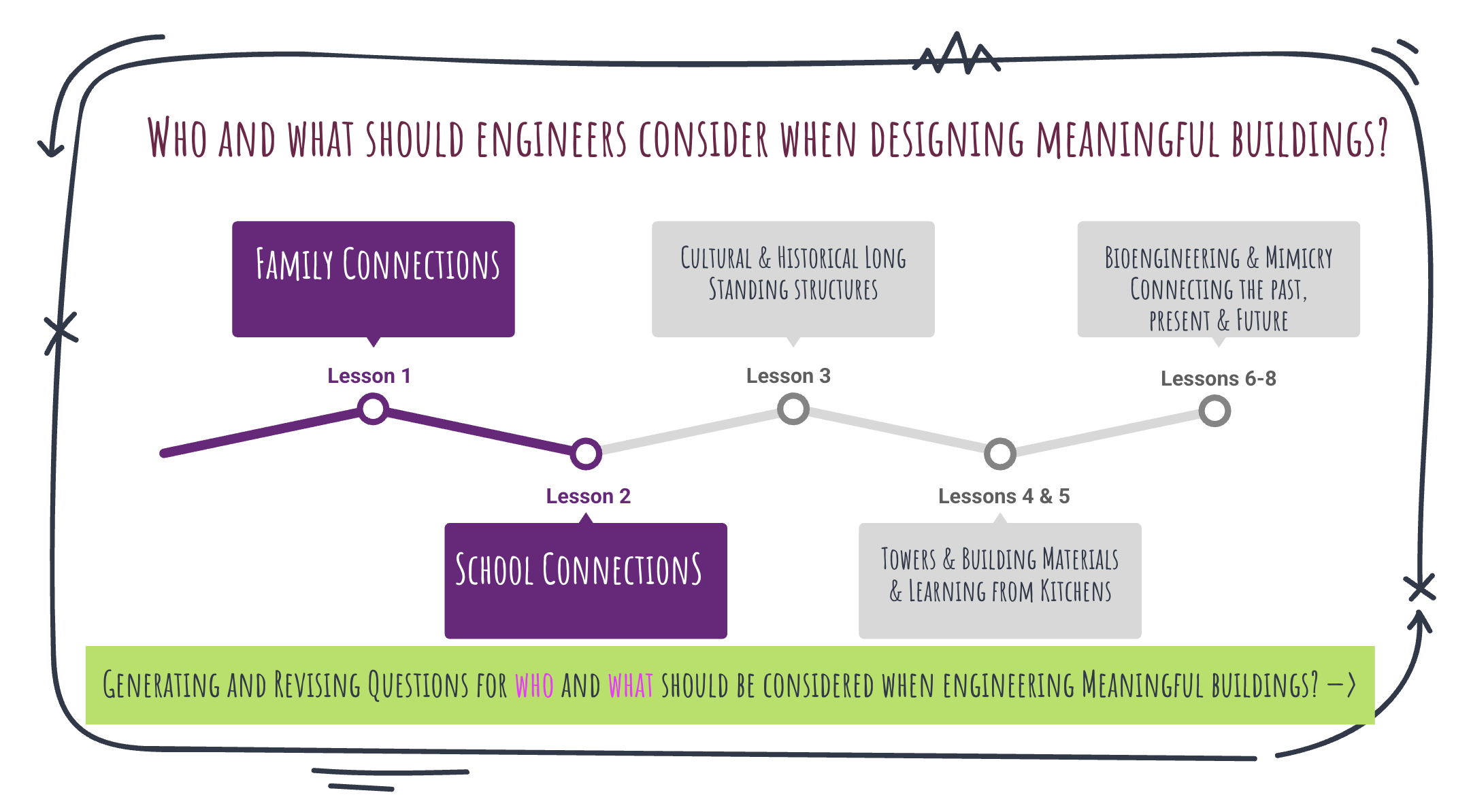
overview of the curriculum in a time line format

Details for the first 3 lessons, also see the curriculum

Lesson 1

  1. Introducing the Unit Question: Who and what should engineers consider when designing a meaningful building?
  2. Students share the meaningful buildings their families have chosen, what materials were used to build them, and why. The teacher maps a map of all examples.

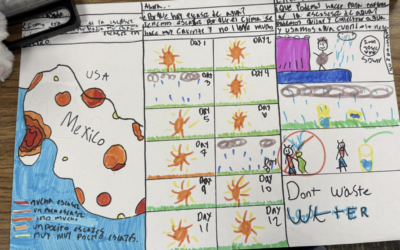
student examples of meaningful buildings

world map with students' examples

Lesson 2

  1. Wondering walk. Take pictures of students and their noticings. Students may notice various parts of the school made of different materials that are falling apart or breaking down.
  2. Share the history of the school building to extend students’ wondering and understanding of the need for engineers to think about maintenance and rebuilding. 

student examples of broken materials from the playground

Lesson 3

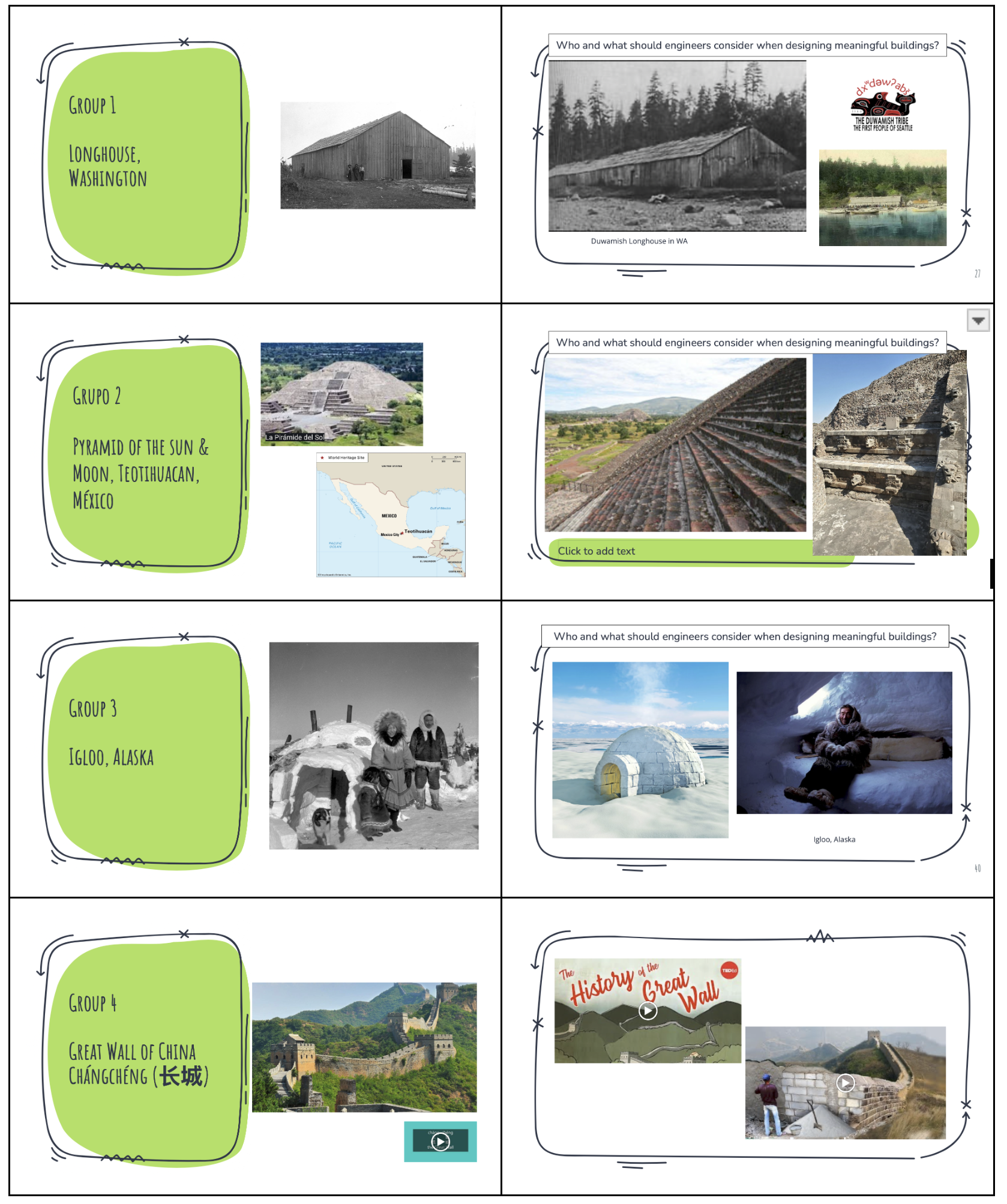
  1. Small groups with cultural and historical buildings. Photos and videos of the chosen location/structure are provided, and students answer guiding questions that further extend their interests and learning as engineers. Facilitate and record students’ wonderings and answers to the guiding questions.   

powerpoint slides of four structures, longhouse, igloo, great wall, pyramid of the sun

posters with sticky notes for the great wall and the igloo groups

Throughout the unit, have students write and revisit a set of questions about: Who and what should engineers consider when designing meaningful buildings?

Equity

Teacher Iman’s lesson supported equity in these ways:

Elevating multilingual students’ and their families’ funds of knowledge, and positioned them as rightfully belonging 

  • Sent home family letter to elicit their ideas and experiences with meaningful buildings 
  • When students mentioned places like Turkey, they used Turkish. 
  • Some students said we should consider the homeless population when designing and building structures.

Fostering Interdependent Nature-Culture Relations and Challenge Western Narratives

  • The wonderment walk empowered students to voice what they noticed in their school and community. It also raised students’ awareness of how nature (e.g., bomb cyclone/natural disasters/climate) interacts with building materials and vice versa. Students also started to notice human impacts on buildings/structures to consider the various factors for things to (not) break down (e.g., high traffic areas, strength of materials, maintenance, who is responsible for caring/maintaining/keeping, moss growing between the cracks, snails eating stucco, the carbon footprint of building different structures)  

Addressing Issues of Power and Historicity

  • The wondering walk and following activities got students theorizing about historicity. The class learning and conversation moved on to questions like (1) if buildings should last forever, (2) how do school districts build new schools? (3) How do they decide/prioritize funding for fixing/rebuilding schools? These historicity learning echoed and moved beyond the NGSS standards on scale and time. 
  • We selected videos, i.e., for the long house and the Great Wall of China, that shed light on the underlying power dynamics and purposes of building different structures. This helped open conversations about power dynamics, but small group conversations also required teacher facilitation to support students’ questions about issues related to power, i.e., colonialism and gender dynamics.

Stories

“The students were deeply engaged throughout each activity. This day of science was so different from anything we had done previously in the year and much more engaging than when I taught the same unit the year prior.” -Teacher Iman

Listening to What Students Share and Getting to Know What’s Meaningful to Them 

During the students’ whole group sharing activity, where students presented the places/structures meaningful to them and their families, we noticed a lot of students making personal connections and comments on each other’s chosen places. The prompt was open enough so that students’ families had the freedom to choose. We noticed students whose families were from the same place/have visited the same place were excited to make connections when the photo of the place was presented. Students were also expanding and redefining the idea of “structure” from a place that is built to places like a tulip farm, a play structure, and art pieces. These places have histories and connections. A couple of students even offered structures that they themselves designed! This activity helped teacher Iman to learn more about her students and appreciate their rich contributions to their collective learning.   

Below we share a few conversations among teachers and 2nd-graders as they investigated igloos and the Great Wall. The students move well beyond what structures and address the unit’s central questions of who and what should engineers consider when designing meaningful buildings? And why were different materials used in different parts of the country/world? 

Indigenous Land Loss and Colonialism (5:39-6:16) 

  • Teacher Maggie: And the Inuit people used to build igloos a lot of a lot when they did, like hunting and in the wintertime. But now they don’t build igloos as much because. 
  • Student: Why?
  • Teacher Maggie: Because of something called colonialism.
  • Student: Because of what?
  • Student: What does that mean?
  • Teacher Maggie: Because people came and took the land. 
  • Student: What’s the name again?
  • Teacher Maggie: Colonialism.
  • Student: Colonialism? 
  • Teacher Maggie: Because people came and took the land from the Native and from the Inuit people, and they made cities. And so now a lot of the Inuit people live in the cities, and they don’t build igloos as much anymore. But sometimes they still do when they want to do something in the winter, if they want to go hunting or something.
  • Student: But you can’t. You can only make an igloo in the snow.

Power of Engineering, Inclusivity, and Sustainability

  • Teacher Iman: They might have to even think about how big their family is to think about how big to make the igloo, right? 
  • Student: Maybe they can make a giant…
  • Student: Their igloo is really big! I mean if their family is really big like the igloo…
  • Teacher Maggie: Do you think the igloo is just for one family or could many people be in it?
  • Student: No, many, not many people, because it has to be like a four, like 3 people family.
  • Student: Or if you make it…
  • Teacher Maggie: You’d have to decide … in this question, who or what should we consider…so it’s something you’ll have to consider. 
  • Student: You’d have to make it wider.
  • Teacher Maggie: How many people are in your family?
  • Student: If you made it so big, it’s even bigger than the school, it might be, it might fit a lot of people.
  • Teacher Maggie: How would you do that with those ice blocks?
  • Student: Maybe professional builders can and … 
  • Student: It might take a really long time to make a bigger igloo? 
  • Student: It takes for a …a day. 
  • Student: More than a day! 
  • Student: Yeah!  
  • Teacher Iman: Well, I wonder how long it took to build this school and how long it would take to build an igloo that’s very big… 

Labor & working conditions

  • Teacher Matt: Why was it built?  
  • Student: It’s a border of China. (students seemed drawn toward the idea of constructions being built for national defense) 
  • Teacher Hsin-Jung: So we haven’t talked about who built the wall… 
  • Student: one man. 
  • Teacher Hsin-Jung: Just one man? 
  • Students: No, a lot of men! 
  • Student: I think a lot of men and a lot of girls cuz girls can build stuff too! 
  • Teacher Matt: Do you want to watch a video about who built the wall? 
  • Students: Yeah! 
  • Teacher Hsin-Jung: So that’s our prediction, right, both men and women built the wall. We are going to find out who built the wall. 坐下,我們來看誰蓋長城?(….. Let’s sit and find out who built the wall?). 
  • Teacher Matt: Did you hear it? People were forced to build it. 
  • Student: What happens if they don’t? 
  • Teacher Matt: They were probably sent to prison. 
  • Student: Yeah, you’ll probably go to jail. 
  • Student: Wait… this is (built) before Jesus?
  • Teacher Matt: More than 2000 years ago. 
  • Student: Wait…I thought Jesus was the first one to …..
    (After watching the video) 
  • Teacher Matt: 200 years before the current era, that was before Jesus was born. They started building a long time ago. It was so big. 13 thousand miles. They had to repair it and fix it because there were many tourists visiting it every day. Some people might have died building the wall…  
  • Student: from hunger?
  • Student: Probably some people drop the brick on them?

posters with sticky notes for the great wall and the igloo groups


Teacher Educators & Professional Learning

Studios are premised on the idea that teachers and researchers both seek to provide joyful, dignity-affirming learning for students (Scipio et al., 2025; Keifert et al., 2021; Espinoza et al., 2020). They are a form of job-embedded professional development that takes place during a school day. Before the studio, the Coach or School Team Leader facilitates a common planning meeting with teachers from the school; they design a unit of instruction and lessons for the studio day. On the day of the studio, teachers and others attending studio days (e.g., classroom teachers, coaches, researchers, administrators) engage in multiple rounds of co-planning, co-teaching, and co-debriefing and real-time feedback. To learn more about the studio process, please see our how-to page.

Before Studio Day: Teacher Iman Planning with PASTEL Research Team 

Before the studio day, teacher Iman met her coach and other researchers from the PASTEL research team to co-plan her studio day lessons. The PASTEL research team provided teacher Iman with many resources, and it’s up to her to choose based on her students’ needs. When choosing the activities and contents, they considered students’ interests, prior knowledge, and families’ linguistic and cultural backgrounds. Since this science unit on engineering could be quite technical, they deliberately designed the lessons to incorporate many opportunities for students to make real connections to the learning experiences. So, teacher Iman started the unit by sending home a family letter (in families’ home languages) for them to share a place/building/structure that’s meaningful to them.

During Studio Day: 

  1. Teacher Iman started the lesson with the Unit Question: Who and what should engineers consider when designing meaningful buildings?
  2. Using the document camera and the classroom computer, students came up to the front to share the meaningful buildings their families have chosen. As students shared, teacher Iman prompted them to share what materials were used to build it and why.
  3. Teacher Iman then showed students other structures (e.g., stucco) and asked students the following questions. She used a reading linked to the literacy curriculum. 
  4. Building on these learnings on engineering structures and materials so far, teacher Iman led the class to do a wondering walk. Before the class headed out, teacher Iman asked these questions. As students gathered at these places to wonder together, teacher Iman took photos of them and took mental notes of their wonderings.  
  5. Through teacher Iman’s facilitation, supported by the pictures she took of her students and the structures, students enthusiastically shared with the class what they noticed and learned during the wondering walk. Students noticed various parts of the school made of different materials that were falling apart or breaking down.
  6. Building on students’ collective wonderings about school structures and materials, teacher Iman gave a brief school history lesson on when the school first opened and when it was renamed and rebuilt. This extended students’ wondering and understanding of the need for engineers to think about maintenance and rebuilding. 
  7. Then the class transitioned into students’ self-chosen small groups, where they observed photos and videos of the chosen location/structure and answered guiding questions that further extended their interests and learning as engineers. Teacher Iman and the PASTEL teachers and researchers joined each group to facilitate and record students’ wonderings and answers to the guiding questions.   
  8. Students return to the whole group to share their noticings and wonderings about their chosen buildings/structures. As students shared, teacher Iman asked follow-up and clarifying questions and encouraged the whole class to identify patterns between different structures. 
  9. Building on their studio day learning so far, teacher Iman updated the class’s question to the unit question: Who and what should engineers consider when designing meaningful buildings?


Studio Reflections on Community Care & Extending Students’/Families’ Engineering Ideas and Agency

 Upon reflection of the studio day, teacher Iman took up other PASTEL teachers’ suggestions as she thought about her next steps. She would like to extend the studio day’s learning to continue engaging students and their families’ engineering ideas and agency. She thought it would be valuable to invite students and their families to design and build the school (e.g., dream school project) so they can further explore material choices (e.g., local or nonlocal), design (e.g., biomimicry), and natural factors (e.g., climate change, earthquake). She thought that students could then pitch their ideas to the principal and other stakeholders (e.g., school janitor, community members). To extend the learning beyond the curriculum, teacher Iman thought about incorporating guest speakers and field trips. 

Studio day professional learning six step model

picture of studio PDF with learnings from the day

Research

Related Posts

This site is primarily funded by the National Science Foundation (NSF) through Award #1907471 and #1315995